

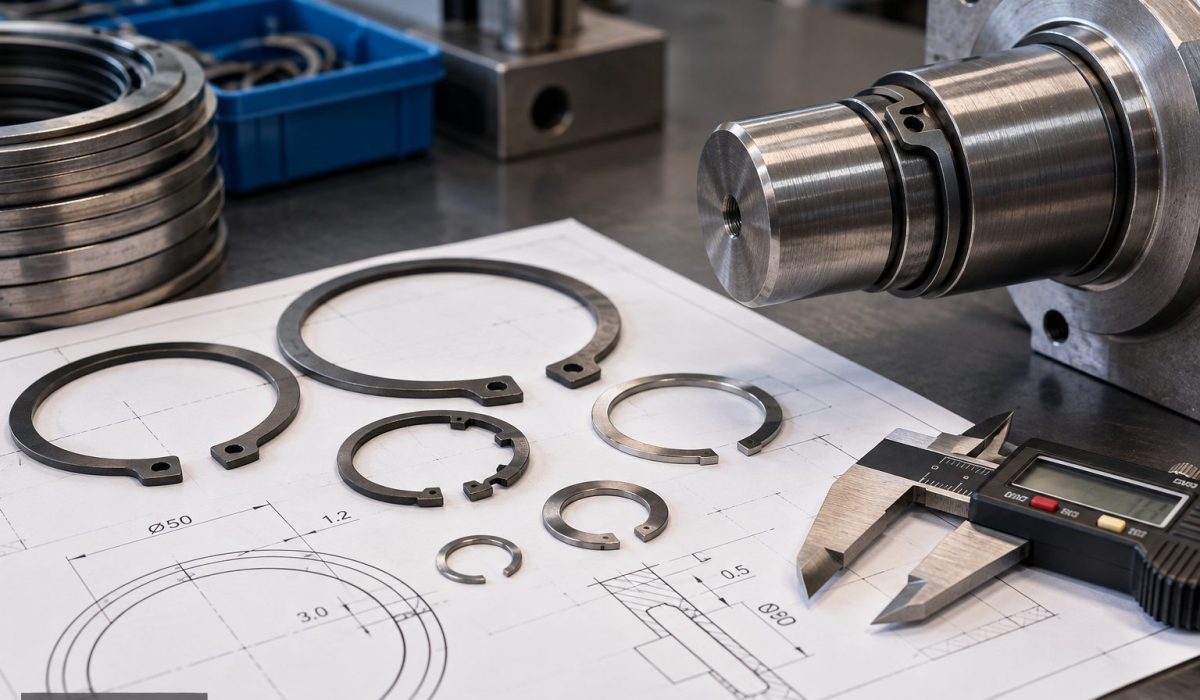
Locking rings and retaining rings serve the same broad purpose – axial constraint – but differ in how they engage their track and distribute load.
• Material selection and dimensional tolerance are the two most consequential decisions when specifying either ring type for a precision application.
• Rings manufactured to exact thickness specifications, from 0.1 mm to 25.0 mm, allow engineers to match the ring geometry precisely to groove dimensions without compromising fit integrity.
In precision assembly, the terms locking ring and retaining ring are often used interchangeably on the shop floor – but the components they describe differ in geometry, load behaviour, and fit requirement in ways that matter when tolerances are tight.
Both ring types secure axial movement, but the mechanism differs. A locking ring – also called a snap ring – engages a groove or track to create a fixed, load-bearing interface. A retaining ring relies on radial tension or a seating surface to hold a component in place. That distinction determines how each ring behaves under load and which one is right for a given application.
Hagens produces both types, made to exact customer specifications based on international standards. The company's locking rings are manufactured in thicknesses ranging from 0.1 mm to 25.0 mm, covering a wide range of industrial needs.
How Each Ring Behaves Under Load
A locking ring seated in a track distributes axial force across the groove face, making it well suited for applications where fixed, stable engagement is required over time. It does not rely on radial tension to stay in place – it sits in a groove and locks the assembly together directly.
A retaining ring that relies on radial tension can relax under sustained load or thermal cycling, leading to micro-movement. In high-vibration environments, the difference between a locking ring and a tension-based retaining ring is the difference between a stable assembly and a failed one.
Groove-fit precision is therefore critical. If the ring does not engage the track correctly from the start, it will not perform as intended under load.
Dimensional Tolerances and Track-Fit Requirements
The relationship between ring thickness, groove depth, and axial play is where most specification errors occur. A small deviation in thickness – across a production range from 0.1 mm to 25.0 mm – directly affects whether the ring seats correctly or introduces clearance that leads to fretting or fatigue.
When ordering a locking or retaining ring, an engineer must define the following dimensional variables in full:
• Ring thickness (critical for groove depth matching and axial load capacity)
• Groove or track dimensions (width, depth, and corner radii)
• Material properties (Young's modulus, yield strength, and elongation)
• Radial clearance (if the ring is tension-based rather than groove-engaged)
• Environmental exposure (temperature range, corrosion risk, and lubrication presence)
Thinner rings demand tighter tolerances. A 0.1 mm locking ring is not a scaled-down version of a 1.0 mm ring – the geometry, deflection, and seating integrity change with material thickness. Engineers working with thin-section assemblies must specify thickness and groove dimensions with equal precision to avoid failure in service.
The full list of parameters and tolerances across the complete thickness range is available at hagens.com/locking-rings/ – a practical reference for engineers matching a ring to a groove in high-precision applications.
Material Considerations by Application
Spring steel is the standard for most locking and retaining rings due to its high yield strength and predictable deflection. Stainless steel grades suit corrosive or hygienic environments; higher-alloy options are reserved for elevated temperatures or fatigue resistance.
Material and thickness must be specified together. A 0.5 mm ring in hardened steel will have a different load curve and seating stability than a 3.0 mm ring in the same material.
When to Choose a Locking Ring Over a Retaining Ring
Here is a quick guide to when a locking ring is the better choice:
• High-vibration assemblies where groove engagement is non-negotiable. A locking ring seated in a track will not migrate like a tension-based ring.
• Applications requiring disassembly and re-seating. A snap ring can be installed and removed multiple times without losing its form or load-bearing integrity.
• Thin-section assemblies where radial space is constrained. A locking ring engages axially and does not require the radial clearance a tension-based ring does.
• Cases where international standard compliance drives the specification. Locking rings are defined in ISO and ANSI standards, with well-documented dimensional ranges for precision use.
Specify the groove first, then choose the ring type and material that match it.