

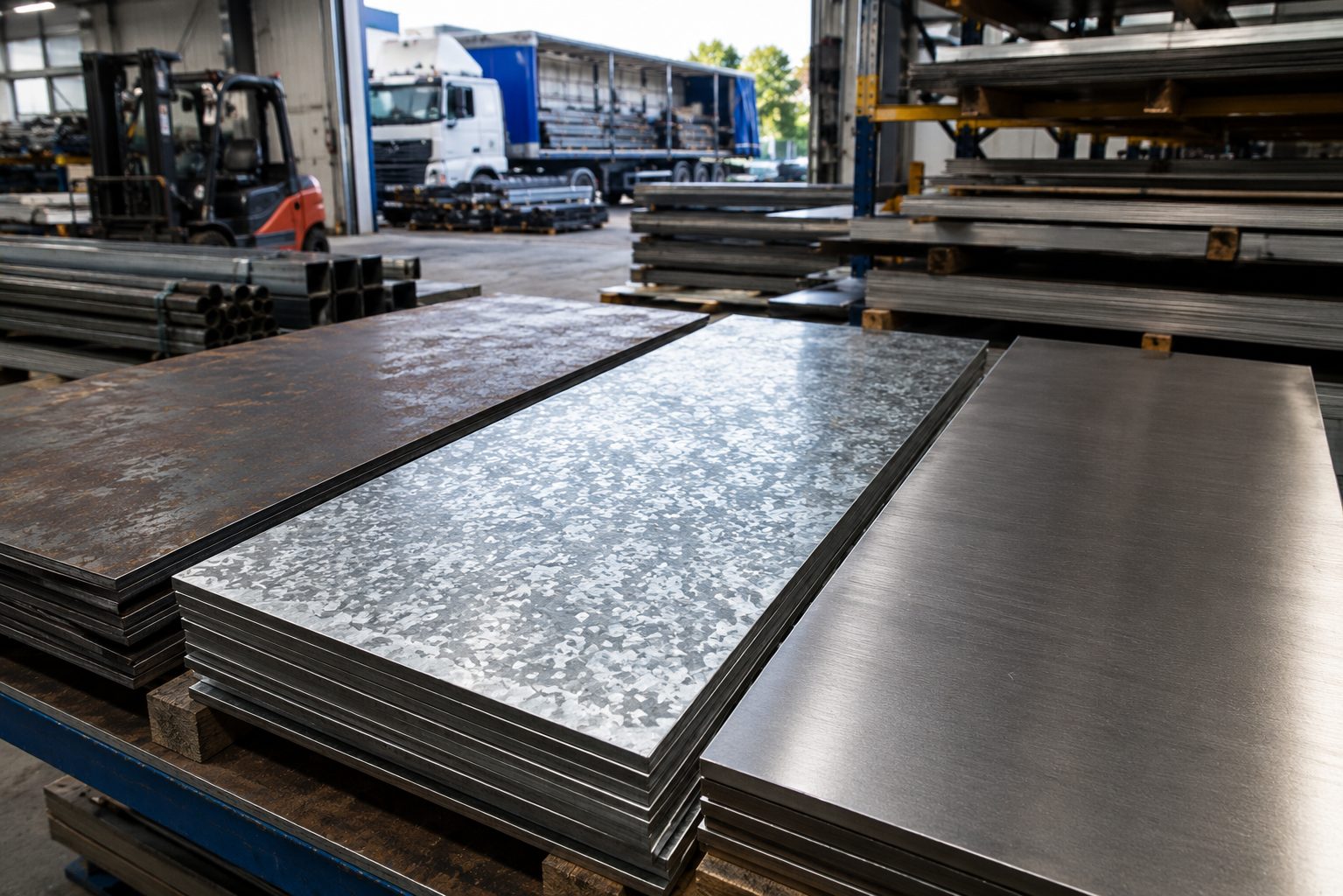
Two steel plates identical in dimensions and finish, pulled from the same warehouse, still carry different price tags depending on when and how they are ordered. That surprises most private buyers renovating a garage or building a workshop. The market price quoted on financial news each morning is only a starting point, not the number stamped on the invoice.
Why identical plates carry different price tags
The market price for the metal reflects raw material cost alone: iron ore and scrap, plus the energy burned in smelting. Everything that happens after the melt gets priced separately: cutting and treatment get their own line, and so does the size of the order itself. A distributor like Tibnor Steel adds these layers on top of the base commodity figure, which is why a quote from a warehouse rarely matches the headline number from a market index.
Alloy content sets the baseline cost
Alloy content changes the price per kilogram directly, before anything else enters the calculation. Chromium and nickel drive the cost of stainless grades in particular, since these elements trade as commodities with prices that move independently of the base metal. A plate alloyed for corrosion resistance therefore costs more to produce than a plain carbon grade.
On paper, two plates cut to identical dimensions may differ in price by 30 to 50 percent on alloy content alone. A structural buyer who compares quotes on metals without first checking the material certificate is looking at the wrong thing entirely.
Cutting method introduces a second variable that rarely shows up in a quick quote. A shape cut with plasma or flame costs more per meter of edge than one simply sheared to a rectangle, because the heat-affected zone needs extra finishing to stay within tolerance. Buyers who send a nesting-friendly drawing, one that lets the distributor cut several parts from a single sheet, often see a lower price per part without changing the alloy at all.
Surface treatment adds a cost most buyers miss
Galvanizing and precision grinding each require extra labor hours on top of the base plate, and painting adds further drying and handling time. Straight from the mill, a raw plate looks cheaper on the invoice, but that is often an illusion.
An untreated plate left outdoors starts showing surface rust within weeks, since bare steel has no barrier against moisture once it leaves the mill’s oil coating behind. The buyer ends up paying for sandblasting and coating later, usually at a higher rate than if the distributor had handled it internally during processing. The cheapest material at checkout is not the same as the cheapest material over its working life.
Order volume and lead time decide the final price
Volume changes the math. A full pallet ordered from stock costs less per plate than a single cut piece pulled and processed on short notice, since setup time and handling do not scale down with a smaller order.
Rush delivery adds another layer entirely. An order placed with only 24 hours’ notice, cut outside the normal production schedule, carries an urgency premium that a job booked three weeks out and shipped on the regular route never sees. In practice, the biggest single swing on a private buyer’s invoice often comes not from the material itself but from how much lead time the supplier gets. A distributor’s yard usually keeps buffer stock only for standard alloys; a specialty grade gets cut against a firm order, so asking about alloy availability before fixing a delivery date avoids a second wait.
The final price on a finished plate is the sum of raw material, alloy, surface treatment, and logistics, never a single number lifted from a commodity index. Ask a supplier for the alloy grade and surface finish, plus the delivery window, before setting two quotes side by side. The one with the lower number up front is not always the cheaper plate in the end.